Structural Drying and Dehumidification in Compton, CA
Once accessible water is removed, framing, drywall, flooring, cabinets, and masonry can still hold moisture. Compton dryout uses repeated material readings to direct equipment and access.
(888) 563-9619Arrange a controlled dryout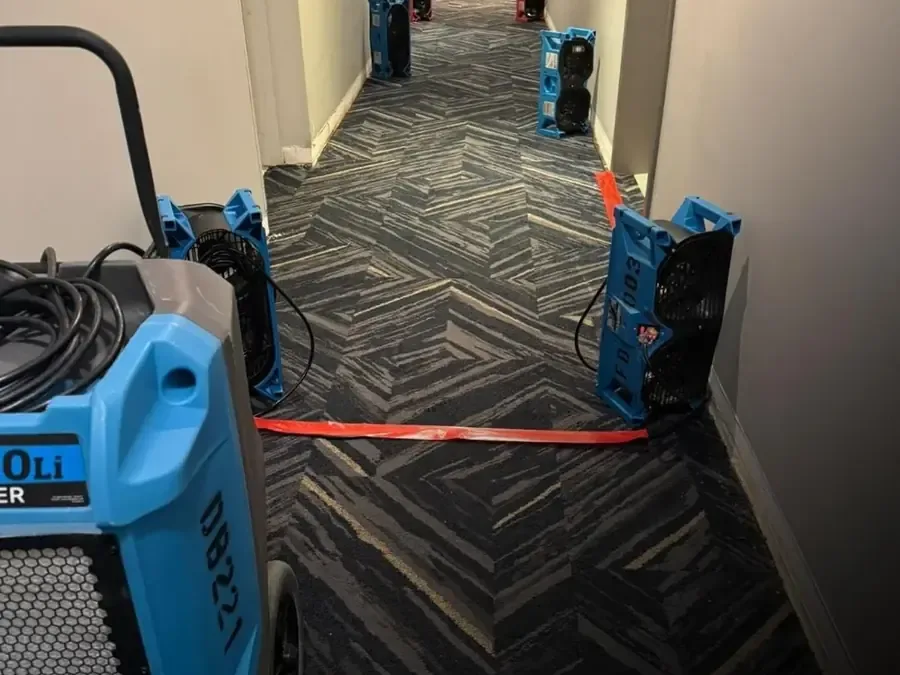
Structural Drying and Dehumidification at a glance
First steps for structural drying and dehumidification in Compton
Preserve equipment placement
Do not move or unplug drying equipment unless safety requires it or the project contact directs a change. Keep the documented layout available for each monitoring visit.
Keep test points reachable
Avoid stacking contents against mapped walls, floor edges, cabinets, or framing locations.
Report changed conditions
Mention new water, equipment shutdown, unusual heat, or a breached work boundary promptly.
Follow access controls
Keep containment, doors, and protected routes in the documented position between monitoring visits.
Extraction removes water that tools can recover. Structural drying addresses what remains inside building materials. At a Downtown Compton property, technicians create a baseline for each affected assembly rather than treating the entire room as one moisture value.
Track drying in each wet material
Drywall, framing, wood flooring, cabinets, and masonry accept and release water differently. Repeat measurements use the same locations whenever practical. A nearby unaffected point helps interpret whether a material is approaching its normal condition.
In Richland Farms, no foundation or soil pattern is assumed. At Leland, wall construction and insulation are likewise confirmed on site. These findings determine whether surface airflow is enough or a focused opening is needed.
What does structural drying and dehumidification cost in Compton, CA?
Contained structural drying commonly costs $1,400 to $7,200. Material volume, cavity access, room conditions, contamination controls, equipment needs, and monitoring duration influence the total.
Focused material zone
$1,400 to $2,800- Small wet boundary
- Reachable surfaces
- Short monitoring path
Several assemblies
$2,800 to $7,200- Walls and flooring
- Cavity access
- Equipment adjustments
Complex drying system
$7,200 to $14,400- Multiple zones
- Concealed materials
- Extended verification
Ranges are typical, not a quote: category of water, square footage, material class and how fast drying started move the number most. Run the water damage cost calculator for a closer range.
The structural drying and dehumidification process in Compton, step by step
- 1
Establish a baseline
Record materials, locations, initial values, room conditions, and suitable references.
- 2
Build the drying zone
Place airflow and dehumidification around exposed surfaces and controlled boundaries.
- 3
Read the trend
Return to consistent points and adjust equipment or access from measurable change.
- 4
Verify the slow point
Close drying only after the most persistent assembly reaches its supported comparison.
Balance airflow with dehumidification
Air movers encourage moisture to leave exposed material. Dehumidifiers collect vapor from the controlled space. Equipment quantity and placement are adjusted when material trends, room conditions, or access show that one area is improving slowly.
- Keep equipment positions undisturbed
- Report unusual heat, noise, or shutoff
- Leave doors and containment as directed
- Do not cover wet materials
- Preserve monitoring access to test points
Near Gateway Town Center, separate zones can support occupied commercial space. In Sunny Cove, a smaller residential loss may use a different layout. Both plans depend on measured load rather than neighborhood assumptions.
Recheck the areas that dry last
The water extraction service explains the preceding liquid recovery step. The Local service hub connects drying with roof, pipe, sewage, appliance, and storm sources.
Investigate readings that stop falling
A material that changes slowly may have restricted airflow, wet insulation, a concealed layer, or continuing water. Technicians compare the location with the rest of the drying zone before changing equipment. A new opening is considered only when the measurement pattern supports access.
Room temperature and humidity help describe the drying environment, but material readings remain central. A favorable room condition cannot prove that a cabinet base, subfloor edge, or enclosed framing member has reached its goal. The completion file therefore connects environmental conditions with the final result at every persistent test point.
Final checks include wall bases behind fixed cabinets, where restricted airflow may leave a small pocket damp.
Structural drying and dehumidification across Compton and nearby towns
Structural drying is available in Downtown Compton, Richland Farms, Leland, and Sunny Cove. Direct material readings set each equipment plan. Related services appear on the town hub. Every material receives its own trend and supported completion comparison.
The same service nearby: structural drying and dehumidification in Lawndale, Gardena, Torrance.
Related water damage services in Compton
Structural Drying and Dehumidification questions in Compton, CA
Still dealing with structural drying and dehumidification?
Share the source, extracted areas, materials still wet, and any access or occupancy constraints.
Why is extraction not enough?
Recovery tools remove accessible liquid, but framing, drywall, flooring, cabinets, and masonry can retain water that must evaporate under controlled conditions. That smaller retained load still requires direct measurement by material.
What does an air mover do?
It moves air across exposed wet surfaces so retained moisture can enter the room air and be collected by dehumidification. Dehumidification must collect the additional vapor released into the zone.
Why are readings repeated at the same places?
Consistent locations show whether each material is improving, stalled, or affected by a new condition rather than producing unrelated numbers. Trend charts make those changes comparable from one visit to the next.
Does every wall need to be opened?
No. Openings are based on contamination, insulation, stability, blocked airflow, and the measured response of the cavity. A stalled cavity can justify focused access after other causes are checked.
Can equipment be turned off at night?
Unplanned shutdown can interrupt the drying trend. Safety concerns or equipment problems should be reported for an appropriate adjustment. Equipment changes should preserve the reason and time in the work record.
How is drying completion checked?
The final decision uses the slowest affected material, an appropriate dry comparison, stable room conditions, and the recorded trend. Each material reaches its own supported goal rather than one roomwide number.
Reach moisture left inside walls and floors
Air movement, dehumidification, containment, and access are adjusted from repeat readings until the slowest location reaches its goal.
Lawndale Water Damage Restoration · Lawndale, CA