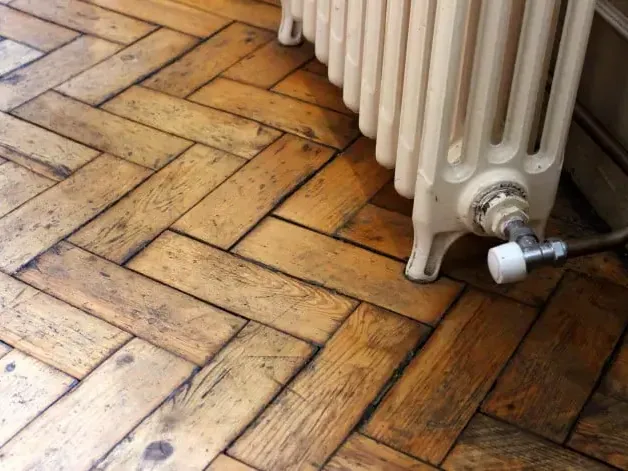
Wet hardwood can show dark seams or cupped edges while the subfloor holds moisture out of sight. The first readings across a Redondo Beach floor record those differences before sanding, heating, or removing boards changes the condition that needs assessment.
Key takeaways
- A board by board map separates the source area, visible change, measured boundary, and dry comparison field.
- Plumbing, appliance, and rain entry can create different cleaning needs before floor drying begins.
- Finish condition, board stability, installation, subfloor access, and measurement trends influence retention.
- Rapid heat or premature sanding can distort the floor and erase useful evidence.
- Completion requires stable readings across the floor field, perimeter, transitions, and accessible material below.
The first map should exist before the floor changes
A wet wood floor may show darkening, raised edges, gaps, finish clouding, or movement underfoot. Those signs matter, but they do not reveal the full depth or boundary.
A moisture map records the floor before evaporation, foot traffic, or repair work alters it.
The map begins at the source and moves across rows of boards. Each reading stays tied to a location and direction.
Matching dry wood in an unaffected area supplies a reference, while wall edges, thresholds, cabinets, and floor openings receive separate attention.
The hardwood floor service treats the visible field and concealed assembly as related layers. A photograph with board orientation helps another reader understand how water moved.
- Photograph finish changes before cleaning or sanding.
- Mark the source and every connected doorway.
- Take comparison readings in matching unaffected wood.
- Record board direction and the widest damp edge.
- Keep furniture off wet areas until movement is planned.
Source condition affects what happens before drying
A supply pipe release, appliance discharge, roof entry, and outside runoff do not create identical cleanup conditions. The observed water and its contact path determine whether the floor needs cleaning, whether absorbent layers can remain, and when directed airflow can begin.
Redondo Beach lies along Santa Monica Bay, and county rain advisories may follow heavy rainfall. Those coastal and public health facts provide storm context, but they do not classify water inside a specific room.
Direct evidence from the opening and surfaces remains necessary.
If the source is still active, the responsible trade controls it. Restoration mapping should begin before the repair opening becomes the assumed floor boundary.
Water can travel along board joints and beneath finishes beyond the plumbing work.
- Identify whether water came from supply, discharge, rain, or runoff.
- Complete required surface cleaning before floor airflow.
- Label repair access separately from the wet outline.
- Check adjoining rooms with continuous flooring.
- Preserve the first readings for later trend comparison.
Edges and transitions often reveal hidden spread
Hardwood can release surface moisture while retaining water near a wall, beneath a rug edge, or at a doorway. Cabinets and fixed trim restrict evaporation.
A transition into tile or another finish can hide water at the joint even when both surfaces look normal.
Inspection extends to base trim, toe spaces, floor vents or penetrations when present, and the opposite side of connected partitions. The purpose is not to open everything.
It is to find the smallest location that provides reliable access to the layer beneath.
North Redondo Beach, Central Redondo Beach, South Redondo Beach, Riviera Village, and Golden Hills orient local service. None of those areas proves a wood species, installation method, subfloor, or foundation at an address.
Retention depends on response, not appearance alone
Boards may remain when they are stable, cleanable, accessible for drying, and improving in a controlled pattern. Severe distortion, lost bond, contamination, trapped moisture, or inability to reach the underside can change that decision.
Premature sanding removes finish and wood while the board dimensions are still changing. Fastening wet boards can lock distortion into place.
Strong unplanned heat may dry the face much faster than the lower portion. Measurements should lead each action.
The water extraction service removes available liquid before the slower floor process. Surface recovery limits additional absorption, while the later system addresses moisture already held in the boards and substrate.
- Evaluate stability and finish bond across the mapped field.
- Compare the face with accessible material below.
- Avoid sanding while dimensions continue to change.
- Use controlled access where a finish blocks evaporation.
- Record why each section remains or is removed.

A floor drying system follows the changing pattern
Depending on the installation and access, the plan may use directed surface airflow, specialty floor equipment, dehumidification, or an approach from below. The equipment choice should match the material path rather than the size of the room alone.
Readings are repeated at the same board locations. As the outer edge reaches comparison, attention shifts toward the source, wall perimeter, cabinet boundary, or deepest accessible substrate point.
Equipment positions can then change without losing the history.
Citywide housing figures show both owner occupied and renter occupied homes. Those figures support planning for different access and authorization paths, but they do not identify any specific home.
The property record should document who approves floor access directly.
Daily comparisons should be made at consistent locations and under similar room conditions. A reading taken beside an open doorway may respond differently from one beneath fixed furniture or near a cabinet.
The log notes those conditions so an apparent improvement is not mistaken for uniform floor recovery. When one row stops changing, the cause may be blocked airflow, deeper material, or continued moisture at the edge, and that area receives focused inspection.
Final readings should tell the complete floor story
A finished map includes the source point, first visible change, widest measured edge, every controlled opening, board locations, dry references, equipment changes, and final results. Matching photographs show the floor before and after the system is removed.
The Redondo Beach restoration hub connects floor work with appliance, pipe, roof, storm, and structural drying services. The floor record should still identify the actual cause rather than treating every service as interchangeable.
Final inspection returns to perimeters, transitions, cabinet edges, and material below the boards. A uniform surface appearance is useful, but stable comparisons across all connected layers provide the stronger completion evidence.
Questions
Does a dark board always need removal?
No. A stained board may remain serviceable. Moisture readings, contamination, the condition of the finish, and access beneath the floor determine whether it can be dried or needs removal.
Why are readings taken board by board?
Water often moves unevenly with joints, grain, source position, and restricted edges. Individual locations reveal the direction and slowest part of the floor.
Can hardwood be sanded immediately after a leak?
Premature sanding can remove material while boards are still changing dimension. Drying progress and stability should be established before finish repair begins.
How is moisture beneath the boards checked?
Accessible edges, transitions, limited openings, and inspection from below may provide evidence. The method depends on the actual installation and property access.
What confirms the floor is ready for repair?
Repeated readings across boards, perimeters, transitions, and accessible substrate reach suitable dry comparisons and remain stable after equipment changes.