Slab Leak Water Damage in Redondo Beach
Suspected water beneath a floor calls for measured tracing from the dampest area outward, without assuming a foundation design or buried pipe arrangement for Redondo Beach.
(888) 563-9619Request slab leak cleanup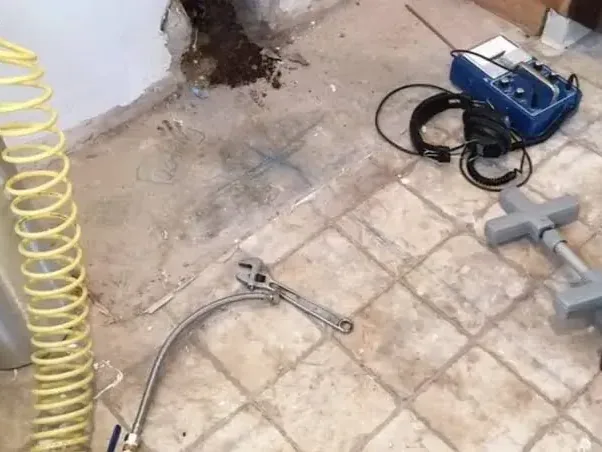
Slab Leak Water Damage at a glance
First steps for slab leak water damage in Redondo Beach
Do not guess at the source
Note warm areas, stains, sounds, or meter changes without opening flooring before evidence is collected.
Control water safely
Use an accessible shutoff only when the approach is dry and no electrical or structural hazard is present.
Photograph floor changes
Record discoloration, lifted edges, swollen trim, and the relationship between affected rooms and fixtures.
Keep finishes in place
Avoid pulling boards or tile until the moisture map and repair access needs are understood.
Recurring floor dampness needs plumbing tests and a careful check of the floor layers. Warm patches, damp baseboards, and unexpected water use help narrow the inspection. Technicians mark wet areas and compare them with dry material before planning access to pipes or trapped moisture.
Locate the leak beneath the floor damage
Plumbing evaluation addresses the active release. Restoration mapping addresses what the escaped water reached. Technicians compare readings across tile, wood, resilient flooring, carpet, wall bases, and adjacent rooms. Test points follow changes in flooring and the spread of dampness, with separate readings for accessible subfloor, wall bases, and cabinet edges.
A Golden Hills home and a property near Anderson Park can have entirely different assemblies. Local names identify service coverage, not construction. Inspection records the actual floor build, accessible edges, plumbing findings, and the route suggested by moisture. This avoids broad claims that could send removal in the wrong direction.
What does slab leak water damage cost in Redondo Beach, CA?
Contained slab leak water damage work commonly costs $1,200 to $6,200. Plumbing access, floor construction, affected area, concealed spread, and material response shape the completed scope.
Localized floor area
$1,200 to $2,400- Confirmed small boundary
- Accessible edges
- Focused equipment
Connected rooms
$2,400 to $6,200- Several finish types
- Wall base testing
- Repeated moisture checks
Complex concealed spread
$6,200 to $12,400- Specialized access
- Selective finish removal
- Longer monitored drying
Ranges are typical, not a quote: category of water, square footage, material class and how fast drying started move the number most. Run the water damage cost calculator for a closer range.
The slab leak water damage process in Redondo Beach, step by step
- 1
Confirm the actual assembly
Identify the floor finish, accessible edges, adjoining walls, and plumbing evidence without assuming local construction.
- 2
Plot moisture intensity
Compare readings through the damp center, transition areas, and suitable dry points to establish direction.
- 3
Coordinate limited access
Choose openings that support plumbing repair, water recovery, and airflow while preserving sound finishes.
- 4
Track retained layers
Monitor the slowest floor, wall base, or subfloor point until the readings reach the documented target.
Open the floor where inspection requires access
Extraction begins wherever liquid can be reached without unnecessary demolition. If moisture is trapped beneath an impermeable finish or within a wall base, access is considered from the side that protects the greatest amount of sound material. Loose flooring, lost adhesion, swelling, contamination, or a stalled drying trend can change the decision.
- Document the suspected source and shutoff status
- Compare each finish with a dry reference area
- Trace moisture into adjoining walls and rooms
- Coordinate plumbing access with the drying plan
- Record the slowest point through completion
One especially useful check is the transition between damp and unaffected finishes. A sharp change may narrow the investigation, while a broad gradient can support additional testing along walls, cabinets, or neighboring rooms before access is chosen.
Dry materials left after the plumbing repair
Stopping the release does not remove moisture already held in the building. Air must reach the wet layer, and dehumidification must collect vapor released into the work zone. Daily readings reveal whether the selected path is working. The structural drying page explains monitoring, and the Redondo Beach hub connects other source specific services.
Slab leak water damage across Redondo Beach and nearby towns
Service reaches Golden Hills, El Nido, North Redondo Beach, and areas around Anderson Park. No neighborhood name supplies a foundation assumption. The local restoration hub lists related help for other sources.
The same service nearby: slab leak water damage in Lawndale, Hermosa Beach, Torrance.
Water damage restoration in Redondo Beach · every town covered
Related water damage services in Redondo Beach
Slab Leak Water Damage questions in Redondo Beach, CA
Still dealing with slab leak water damage?
Describe the floor symptoms, nearby fixtures, shutoff status, and rooms where changes appear.
Does a warm floor prove a slab leak?
No. It is one observation. Plumbing testing, moisture readings, source history, and the actual floor assembly are needed before assigning the cause.
Are all Redondo Beach homes built on slabs?
The inspection identifies the foundation and floor layers at the affected property. Accessible edges, plumbing routes, and openings help determine where testing and drying equipment can reach.
Must the entire floor be removed?
Not necessarily. Stability, finish response, contamination, access, and measured drying progress determine whether an area can remain.
How are hidden boundaries estimated?
Readings are taken along rows and material changes, then compared with dry points. Accessible edges can provide additional evidence about concealed layers.
Can drying begin before plumbing repair?
Available water can be recovered and safe areas stabilized, but an active release must be controlled for the assembly to make dependable progress.
Why might a wall be included?
Water beneath flooring can reach trim, drywall, cabinets, or partitions. Direct readings establish whether those connected materials joined the loss.
What happens at the final inspection?
The source is controlled, repair access is documented, and the slowest retained material reaches a target supported by dry comparison readings.
Can one high floor reading identify the pipe route?
No. A pattern across repeated points, plumbing findings, material changes, and accessible edges provides stronger evidence than one isolated measurement.
Trace recurring dampness beneath the floor
Technicians compare finishes, identify connected wet materials, coordinate access, and verify the slowest location before completion.
Lawndale Water Damage Restoration · Lawndale, CA