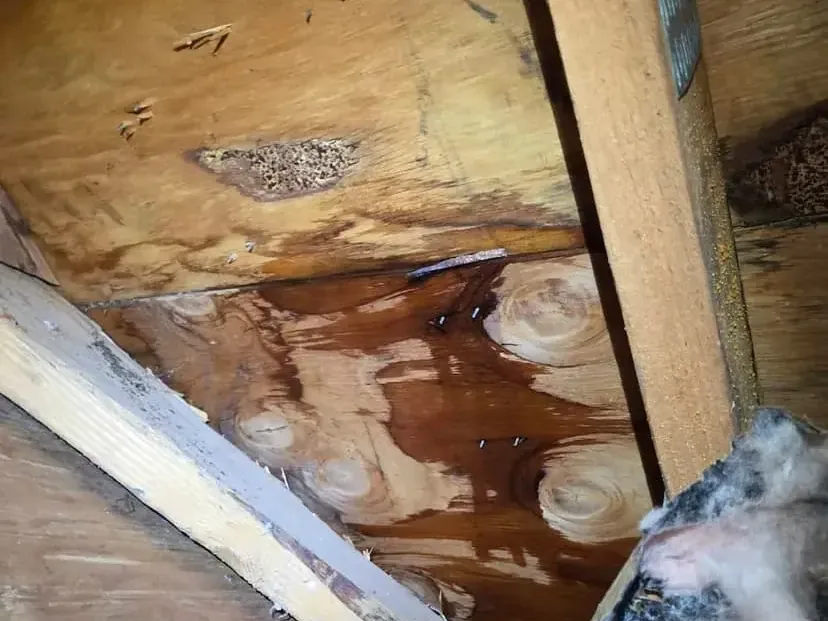
A ceiling stain during the Hermosa Beach rainy season needs a closer look above the room. Rain may have entered through the roof, while plumbing and condensate leaks can produce similar marks. Inspection traces the source and checks wet insulation and framing.
Key takeaways
- The local rainy season generally runs from late October through late March, making weather timing useful context for an overhead investigation.
- A lower stain may sit away from the actual entry because water can travel along framing, seams, insulation, and penetrations.
- Bowed finish, wet fixtures, or electrical involvement require a cleared fall zone before drainage or access.
- Roof protection and interior restoration are documented as different actions.
- Ceiling, wall top, insulation, and framing readings close separately.
Rain timing narrows the questions without proving the answer
The local rainy season generally extends from late October through late March. Winter storms commonly approach the region from the northwest, and the city averages about 14 inches of rain per year.
Those facts help build a weather timeline, but they cannot identify the opening in a particular roof.
A March 2025 storm placed Los Angeles County under a flood watch, and Los Angeles County Public Works activated continuous storm patrols. That regional event confirms significant weather conditions, while the building still needs its own roof observations, interior marks, and moisture readings.
The roof leak cleanup page follows the route from exterior opening to attic or ceiling materials. The first record should state when the mark appeared, whether it changed with rain, and what temporary protection was added.
- Photograph the stain before its edge expands or dries.
- Record rain timing and each visible interior change.
- Note nearby roof openings, fixtures, and cooling equipment.
- Keep temporary catchment separate from source repair.
- Preserve access to the corresponding space above.
The room beneath the leak becomes a safety zone
Water adds weight to drywall, plaster, and insulation. A bowed section or dripping fixture can release water and material suddenly.
People, pets, furniture, and electronics should remain beyond the affected ceiling area until drainage and support are planned.
Puncturing the lowest point without preparation can create an uncontrolled discharge. It may also erase clues, spread water across the floor, or expose an electrical condition.
Controlled drainage uses floor protection, a planned opening, and a way to document what the cavity releases.
The ceiling leak service maps the upper and lower spaces together. A photograph from each level helps relate roof planes, fixtures, equipment, and wall positions with the mark below.
- Clear the floor beneath sagging or wet finish.
- Do not touch wet lights, fans, or electrical devices.
- Keep ordinary foot traffic outside the fall zone.
- Photograph seams, wall intersections, and ceiling fixtures.
- Wait for controlled access before moving weakened material.
Roof entry leaves a sequence of evidence
An exterior opening can admit rain into roofing layers, insulation, framing, and ceiling finish. Water may then follow a rafter, joist, pipe penetration, or seam before becoming visible.
The inspection works backward from the interior mark while also examining plausible exterior conditions.
Temporary roof protection can stop new entry, but it does not remove water already held inside. The file should distinguish the original roof condition, the protection added, any later repair, and the indoor drying period.
That sequence prevents a covered opening from being mistaken for a dry assembly.
For a property near The Strand, Pier Avenue, North Hermosa, or the Sand Section, the roof inspection records the covering, slope, access points, and previous repairs. Indoor stain photographs help connect those observations with the rooms below.
Plumbing and condensate remain competing explanations
A stain may appear during rain while a plumbing fixture or cooling component also occupies the upper area. The assessment should not discard those possibilities simply because the weather changed.
Supply connections, drains, pans, and nearby equipment receive their own observations.
Plumbing evidence can include active dripping, a wet connection, or a pattern tied to fixture use. Condensate evidence can include a pan, drain, or equipment fault.
Roof evidence comes from the exterior opening and its connected material path. Each explanation must fit both the upper source and the lower moisture map.
This comparison is especially useful when a stain recurs. A mark that grows only during equipment operation differs from one that changes with rain or fixture use.
The written timeline keeps those triggers distinct rather than combining every overhead loss under one label.
- List recent rain separately from fixture use.
- Inspect cooling equipment without assuming it caused the mark.
- Relate each source clue to the ceiling position below.
- Use direct readings to confirm material moisture.
- Retain photographs before repairs alter the cavity.
Cavity work balances access with preservation
A limited opening can release trapped water, remove affected insulation, and create a path for inspection. The size and position should answer the moisture map.
Stable dry finish does not need to disappear simply to make the work area larger.
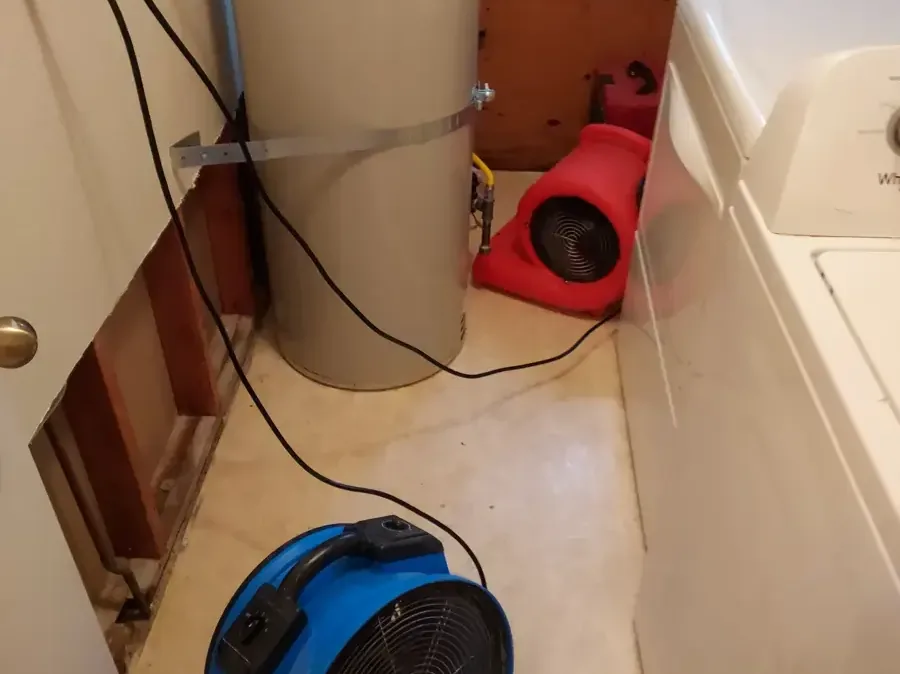
Insulation is judged by saturation, cleanliness, compression, and reach. Damp framing and the rear of retained ceiling material need direct airflow and dehumidification after the cavity is clean.
Wall tops receive attention because overhead water can descend inside a partition beyond the visible stain.
Drying progress is recorded by material. Framing, insulation edges, wall tops, and ceiling finish can change at different rates.
Equipment moves toward the slowest location instead of staying where it was first placed.
Completion joins weather, repair, and interior readings
The final file begins with the weather and stain timeline, then shows source protection, controlled drainage, openings, insulation decisions, and equipment changes. Final photographs match both sides of the assembly so the relationship between roof and room remains understandable.
The Hermosa Beach service hub connects roof, ceiling, extraction, and structural drying work. The closeout should still name which action belonged to each scope.
Roof repair controls the opening. Interior restoration addresses the water already inside.
Completion is reached when retained ceiling, framing, and wall materials meet suitable unaffected comparisons and no connected damp edge remains. Appearance supports the record, but readings establish the endpoint.
Questions
Does a stain appearing during rain prove a roof leak?
No. Rain timing is useful, but plumbing and condensate may also occupy the space above. Direct source evidence and the material path must agree.
Should a sagging ceiling be punctured?
Not without controlled drainage and a cleared area. Collected water, weakened finish, and possible electrical contact can make an unplanned opening dangerous.
Why can the stain sit away from the roof opening?
Water can follow framing, seams, insulation, and penetrations before reaching the lowest visible point. Both sides of the assembly need to be mapped.
Can wet insulation remain?
Retention depends on saturation, cleanliness, compression, access, and response. Material that blocks drying or cannot be reached may need selective removal.
What proves the overhead cavity is dry?
Readings from retained ceiling material, framing, insulation edges, and wall tops reach appropriate dry comparisons and remain documented with final photographs.